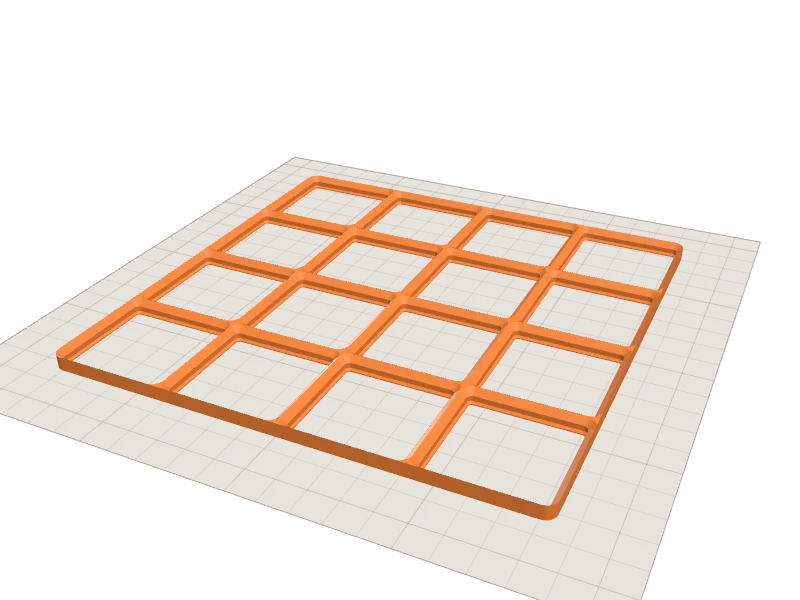
How Gridfinity works
It was invented by Zack Freedman, who released it free for everyone (MIT licence). Since then, thousands of bins and holders have been made for it, and anyone may design their own. You only need to know three sizes:
- A 42 mm grid: A bin is 1, 2, 3 … units wide and deep. So that bins fit side by side, each one is half a millimetre smaller than its grid.
- 7 mm per height unit: Height is counted in units. A bin with 6 units is 42 mm tall, plus the stacking lip on top.
- Feet with slopes: Under each grid unit, a bin has a foot that fits exactly into a pocket in the baseplate. Nothing slides around.
Our generators follow the published Gridfinity sizes, so their bins and baseplates also fit Gridfinity parts from other sites.
Plan your drawer
- Measure the inside of the drawer: width and depth at the bottom, in millimetres.
- Divide both by 42 and round down. A drawer of 300 × 200 mm has room for 7 × 4 units.
- What's left becomes a margin. In the baseplate generator, choose “Drawer” under “Size by” and enter the inside size. It works out the grid and the margin for you.
- Then the height: a bin is 7 mm tall per unit, plus 3.8 mm of stacking lip. A drawer 60 mm high inside takes bins with 7 units (49 + 3.8 mm), with a little room to open it.
Print the baseplate
A large baseplate rarely fits on a print bed. In the generator, enter the shorter side of your bed under “Print bed”: if the plate is bigger, it is split along the grid lines into parts that each fit. Part A1 goes at the front left.
- Open: uses the least filament and prints fastest. Enough for most drawers.
- Closed: with a floor, stiffer, good for workbenches and shelves.
- Magnets: with holes for 6 × 2 mm magnets. Bins then hold more firmly, for example in a toolbox or a drawer that often gets jolted.
Bins and holders
In the bin generator, choose width and depth in grid units and the height in units of 7 mm. Add compartments, a label ledge (12 mm label tape fits), a rounded scoop for small parts and the stacking lip, so bins can sit on top of each other.
Ready-made bins and holders for pens, bits, batteries, drill bits and nozzles are in the Gridfinity starter set. And for the road, the rugged box has a Gridfinity grid inside: your bins simply travel with you.
Printing tips
- No supports, opening up: That's how our bins are designed. The slopes of the feet are exactly 45°.
- PLA is enough for almost everything in a drawer or workshop. In a hot car or garden shed, use PETG instead.
- A 0.95 mm wall is standard and saves filament. 1.2 mm makes a bin sturdier, for example for heavy screws.
- Magnets the right way round: Before pressing them in, check with a magnet from the bin that the two attract. A drop of glue holds them.
- Bin stuck in the plate? Often the first layer is too wide (elephant's foot). What helps is in Parts that fit.