Why parts don't fit exactly
The printer lays down melted plastic as a line. That line swells a little, and curves are made of short straight pieces. So holes usually come out a bit too small and pins a bit too thick. How much depends on your printer, nozzle, filament and settings.
Then there is the elephant's foot: the first layer is pressed flat onto the bed and sticks out slightly. A part that has to fit exactly at the bottom then jams right there.
What is clearance?
Clearance is the gap between two parts that go together, measured per side. A 10 mm pin with 0.2 mm clearance needs a 10.4 mm hole.
- Tight, no wiggle (press fit): about 0.1 mm per side.
- Slides in and holds (lid, plug-in joint): about 0.15 to 0.25 mm.
- Turns freely (axle, hinge): about 0.3 to 0.5 mm.
These are only guidelines. Your printer may be more or less precise, which is why the test is worth it.
How to find your clearance
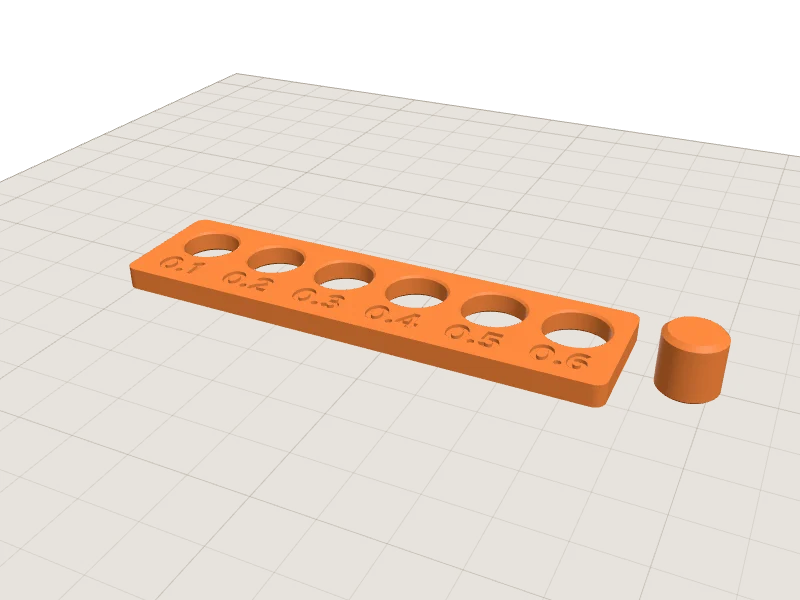
- Open the tolerance test. Choose round or square and a size close to your real part.
- Print the plate lying flat and the pin standing up, with your usual settings and without supports.
- Push the pin into the holes. The number under each hole is its clearance per side.
- Where the pin goes in tightly is your value for firm joints. Where it turns easily is your value for moving parts.
- Enter that value in the generators in the “Clearance” field.
Sets with a fit test
Some sets come with a fit test: a small piece that shows only the critical spot, such as the groove of the roll-top box or the plug of the earbud dock. Print it first. It's done in minutes and saves you a long failed print.
Tips for accurate parts
- Holes pointing up come out roundest. If a hole lies on its side, its top sags a little.
- Compensate the elephant's foot: many slicers have a setting for it. A small chamfer at the bottom of the part helps too; our fidgets already have one.
- Slow down the outer wall: for accurate parts, print the outer wall more slowly.
- Just a hair too tight? A drill bit of the right size, turned by hand, widens a hole cleanly.
Tools for this